Most families have five options when it comes to college application help: a high school counselor, a private independent college counselor, a full-service counseling team, an essay coach, and AI tools.
The best starting point is to understand the benefits and limitations of each option compared to what your student actually needs.
College Application Help at a Glance
| Option | Provider or format | Main support | Best for | Main limitation | Typical cost |
|---|---|---|---|---|---|
| High School counselor | High school staff | School forms, transcripts, recommendations, general guidance | Every student; the only adviser who submits official school forms | Limited one-on-one time, especially at public high schools | Free |
| Private college counselor (IEC) | Independent consultant hired by the family | College list, application strategy and review | Families who want one-on-one strategy from a single adviser | No licensing requirement; qualifications and scope vary | Hourly or package; varies widely |
| Full-service counseling | Coordinated team of specialists | College list building, application management, personalized planning, essay support | Students who need both strategy and one-on-one coaching | Usually the highest cost | Package pricing |
| Essay coach | Writing coach or editor | Brainstorming, drafting, and revising essays | Students whose main challenge is writing | Does not cover college list strategy or application management | Hourly or package |
| AI tools | General chatbots or college-specific platforms | Research, comparisons and checklists | Fast first-pass research and organization | Generic guidance; Answers can be outdated or wrong | Free or low-cost |
Prices for private counselors and full-service college admissions packages vary widely. For more information, check out our article How Much Do College Counselors Cost?
High School Counselors
High school counselors play a necessary role in the college application process. They are responsible for submitting official transcripts, school profiles, and/or midyear reports. They also write recommendation letters, as required by most selective four-year college and universities.
While there’s no substitute for a high school counselor, it’s important to understand how much time they have to spend on college planning, guidance, and feedback.
According to an American School Counselor Association study of 35 states, public high school counselors average an estimated caseload of 195 to 224 students. And the responsibilities of a school counselor extend well beyond college admissions help. A 2021-22 NACAC/EAB survey found that public high school counselors spend 22% of their time on college admission counseling (NACAC), with the other 78% dedicated to personal needs counseling, course scheduling, academic testing, and other responsibilities.
So, how much time is left for college application help?
How Much Time Do High School Counselors Spend On College Admissions?
Based on the available data, HelloCollege estimates that a public high school counselor spends roughly 90 to 105 minutes on college-related tasks per student per year.
To get there, we reran the method behind a widely cited 2005 NACAC estimate of 38 minutes per student per year (McDonough, 2005) using today’s figures.
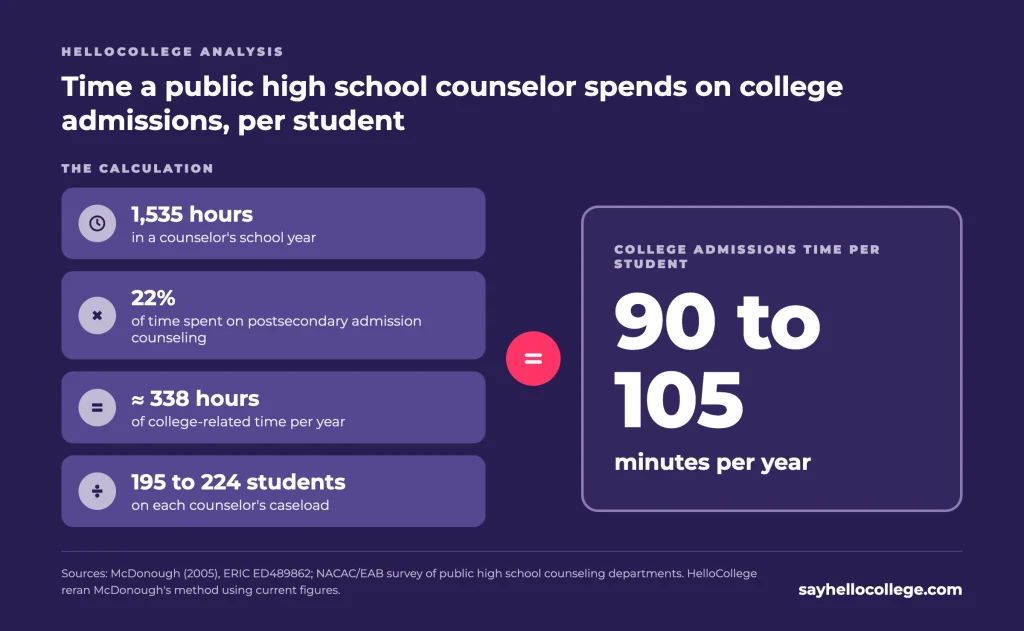
Assuming a high school counselor works approximately 1,535 hours in a school year, 22% of that time, or 338 hours, is spent on college-related tasks. Divided across 195 to 224 students, that is about 90 to 105 minutes per student per year.
A common question we get from families: If students at their school have gotten into Ivy League schools and top 50 universities with only their school counselor, what would outside help add? For a student with clear goals, high grades, and strong organizational skills, school counseling may be enough.
“Some schools have great counselors, some have great counselors who are stretched thin,” says Dan Farnesi, Co-Owner and Senior Admissions Advisor at HelloCollege. For some students, school counseling can be enough. But the real question in making this determination is about capacity, not quality.
For families who determine they need extra support outside of high school counseling, there are options for more personalize guidance.
Private College Counselors and Independent Educational Consultants (IECs)
Private college counselor, sometimes called independent educational consultants, or IECs, are hired to work one-on-one with a student specifically on college applications. IECs can help families explore major and career options, build balanced college lists, review application materials, meet deadlines, and make decisions. The scope of services varies widely across IECs, so it’s important to understand whether things like essay help and financial aid support are included.
The Independent Educational Consultants Association’s Professional membership standards include relevant experience, a master’s degree or equivalent training and experience, three professional references and, for the college specialty, 50 evaluative campus visits within the previous five years (IECA). But there is no state licensing requirement for IECs and credentials alone do not determine fit.
Before choosing any provider, ask:
- What exactly is included?
- How many essay feedback rounds are available?
- Who tracks deadlines?
- How will you coordinate with our school counselor?
Full-Service College Counseling
Full-service college counseling brings several roles into one plan: typically a college admissions counselor and an essay coach, with academic tutoring, test-prep tutoring, interview prep, and financial aid assistance. A well-coordinated team of experts helps students connect all of their tasks, deadlines, essays, and tests to see the bigger picture, rather than treating every aspect of college admissions as separate projects.
At HelloCollege, the admissions counselor acts as the quarterback of the team. They are the student’s main point of contact and own the overall plan: building and refining the college list, mapping deadlines, and reviewing every application before it’s submitted. The student receives support from a dedicated essay coach, picked from a team of (CREDS), to draft and refine the personal statement and supplements. And tutors step in to provide academic and test-prep support in a proactive manner.
HelloCollege’s own data shows how families combine these services in practice. In HelloCollege’s Class of 2026 (580 students who applied in the 2025–26 cycle and used at least one HelloCollege service):
- 92% worked with both an admissions counselor and an essay coach
- 32% used tutoring
- 29% used counseling, essay coaching, and tutoring
The coordination shows up in how families describe the experience. In HelloCollege’s annual exit survey, 99% of families said HelloCollege helped them stay organized and meet deadlines, and 92% of Class of 2026 students were accepted to one of their top three college choices. (See methodology.)
For most families, full-service support centers on strategy and writing, with tutoring added when a student has specific academic or test-prep needs. This is often the most expensive option, so it’s ideal for students who need expert guidance, strategic direction, and personal accountability.
To see how a coordinated team works in practice, visit HelloCollege’s College Admissions Counseling page.
College Essay Coaching
Some students have a good handle on their applications and college to-do lists. But then they add all of their prospective colleges to the Common App and realize they’re staring down a list of 30 or 40 supplemental essays. This is where a college essay coach becomes a valuable option.
A valuable essay coach helps students identify meaningful topics, write with authenticity, and edit while maintaining their original voice. They also help with planning, strategizing, and organizing so every essay is finished before its deadline. And for students with a long list of supplemental essays, a coach can help group similar prompts together and strategically reuse essay material to avoid starting from scratch each time.
This type of support can be a huge time-saver, which is part of the reason essay coaching was the most-used HelloCollege service among the Class of 2026, with 97% receiving it.
For more on where coaching ends, see can you hire someone to help with college essays?
AI Tools
AI can be a useful starting place for help with the college admissions process. Tools like ChatGPT can easily compile research on colleges, majors, programs, scholarships, reviews, and more (though users should always double-check for accuracy). And while a chatbot can’t hold a student accountable, it can turn deadlines into timelines and disparate tasks into organized checklists.
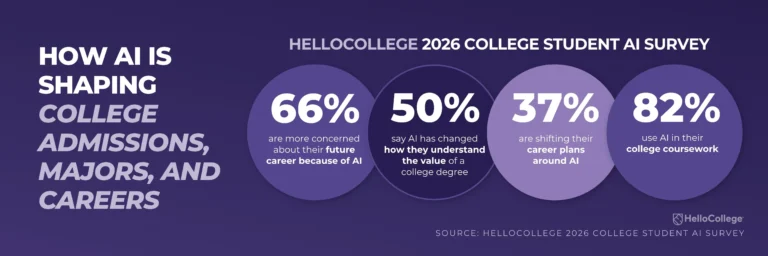
According to a HelloCollege 2026 AI Survey of 1,011 college students, 23% had used AI to identify colleges and 14% for application-related help.
How to choose the right college application help
Start with understanding the free services already available to you and whether they cover your student’s needs. Can your student’s school counselor meet regularly? Does your student need a list-building strategy, essay feedback, or academic support? How many supplements will their college list require? Will they need help with essay writing and test-taking?
HelloCollege counselors use this as a starting point:
| If your student… | Consider |
|---|---|
| Is organized, writes well, and has a balanced college list | School counselor, using every meeting available, with AI support for research. |
| Wants help building a balanced list and an application strategy | Private college counselor (IEC) |
| Wants strategy and one-on-one guidance plus substantial essay feedback | Full-service counseling |
| Has a clear strategy but needs help with writing or managing heavy essay load | Essay coach |
The right choice for college application help is the one that meets your student’s needs. It is the support that fills a real gap while keeping the student responsible for their own applications.
If you’re weighing whether your student needs more than school counseling, talk with a HelloCollege admissions advisor about your student’s situation.